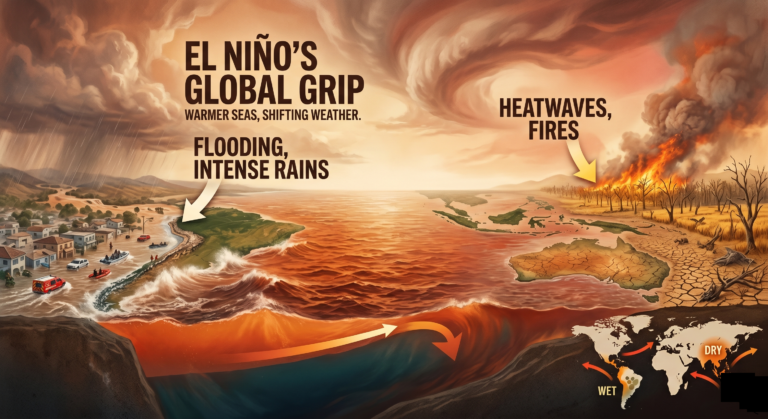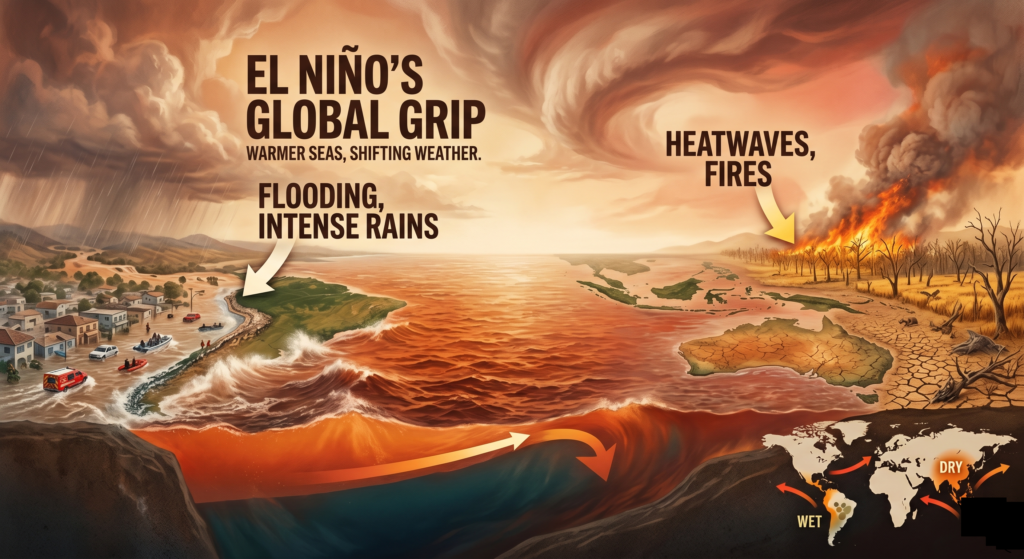
El Niño is one of the most influential climate patterns on Earth. It is a naturally occurring weather phenomenon caused by the warming of sea surface temperatures in the central and eastern tropical Pacific Ocean. Though it begins in the ocean, El Niño can affect weather systems across continents, influencing rainfall, droughts, temperatures, agriculture, marine life, and economies worldwide.
The term “El Niño” comes from Spanish, meaning “The Little Boy” or “Christ Child,” because fishermen in Peru noticed unusually warm coastal waters appearing around Christmas.
What Is El Niño?
El Niño is the warm phase of a larger climate cycle called the El Niño-Southern Oscillation (ENSO). ENSO has three phases:
- El Niño – Warmer-than-average ocean temperatures in the tropical Pacific
- La Niña – Cooler-than-average ocean temperatures
- Neutral – Normal ocean and atmospheric conditions
During El Niño years, warm water shifts eastward across the Pacific, weakening normal wind patterns and disrupting weather around the world.
How Does El Niño Form?
Under normal conditions:
- Trade winds blow from east to west across the Pacific.
- Warm surface water piles up near Indonesia and Australia.
- Cold nutrient-rich water rises near the coast of Peru and Ecuador.
During El Niño:
- Trade winds weaken or reverse.
- Warm water moves eastward toward South America.
- Upwelling of cold water decreases.
- Rainfall patterns shift dramatically.
This ocean-atmosphere interaction changes jet streams and storm tracks worldwide.
Major Effects of El Niño Around the World
1. Increased Rainfall and Flooding
Some regions become wetter than normal:
- Western coast of South America
- Southern United States
- East Africa
Heavy rainfall can lead to:
- Flooding
- Landslides
- Infrastructure damage
- Waterborne disease outbreaks
2. Drought Conditions
Other regions experience reduced rainfall:
- Australia
- India (possible weaker monsoon in some years)
- Parts of Southeast Asia
- Southern Africa
This can cause:
- Water shortages
- Crop failures
- Wildfires
- Heat stress
3. Warmer Global Temperatures
El Niño years often rank among the warmest globally because ocean heat is released into the atmosphere.
4. Marine Ecosystem Disruption
Reduced cold-water upwelling means fewer nutrients for fish populations near South America, affecting:
- Anchovy fisheries
- Seabirds
- Marine mammals
- Coastal economies
El Niño and India
India closely watches El Niño because it can influence the southwest monsoon. In many El Niño years:
- Monsoon rainfall may weaken
- Agriculture may suffer
- Food prices may rise
- Water reservoirs may receive less inflow
However, El Niño does not guarantee drought every time. Other factors like the Indian Ocean Dipole can offset impacts.
El Niño vs La Niña
| Feature | El Niño | La Niña |
|---|---|---|
| Pacific Ocean Temperature | Warmer than normal | Cooler than normal |
| Global Temperature | Usually higher | Usually slightly lower |
| India Monsoon | Can weaken | Can strengthen |
| Australia Rainfall | Often drier | Often wetter |
| Atlantic Hurricanes | Often fewer | Often more |
How Often Does El Niño Occur?
El Niño typically occurs every 2 to 7 years and usually lasts 9 to 12 months, though some events continue longer.
Some El Niño events are weak, while others are strong and cause severe global disruptions.
Famous El Niño Events
1982–83 El Niño
One of the strongest recorded events, causing massive floods and droughts globally.
1997–98 El Niño
Known for major economic losses, extreme weather, and coral bleaching.
2015–16 El Niño
Contributed to record global temperatures and widespread climate impacts.
Economic Impact of El Niño
El Niño can affect:
- Agriculture production
- Food supply chains
- Energy demand
- Insurance losses
- Commodity prices
- Fisheries
- Transportation systems
Countries often prepare months in advance using seasonal forecasts.
Can El Niño Be Predicted?
Yes. Scientists monitor:
- Pacific sea surface temperatures
- Wind patterns
- Atmospheric pressure
- Ocean heat content
- Satellite data
Forecasting agencies such as NOAA and meteorological departments issue outlooks months ahead.
Climate Change and El Niño
Climate change does not directly cause El Niño, but it may intensify some impacts:
- Stronger heat waves
- Heavier rainfall events
- Coral bleaching
- Higher baseline temperatures
Researchers continue studying how warming oceans may influence future ENSO cycles.
How Communities Can Prepare
Governments
- Improve drought and flood planning
- Manage reservoirs
- Support farmers
- Strengthen disaster response
Businesses
- Monitor supply chains
- Hedge commodity risks
- Prepare for logistics disruptions
Individuals
- Save water
- Stay informed on weather alerts
- Plan for heat or flood risks
Conclusion
El Niño is far more than an ocean warming event—it is a global climate driver with the power to reshape weather, agriculture, economies, and daily life. Understanding El Niño helps nations, businesses, and individuals prepare for its impacts. As climate variability grows more important, awareness of El Niño becomes essential for a resilient future.
 20
20
 20
20
 20
20